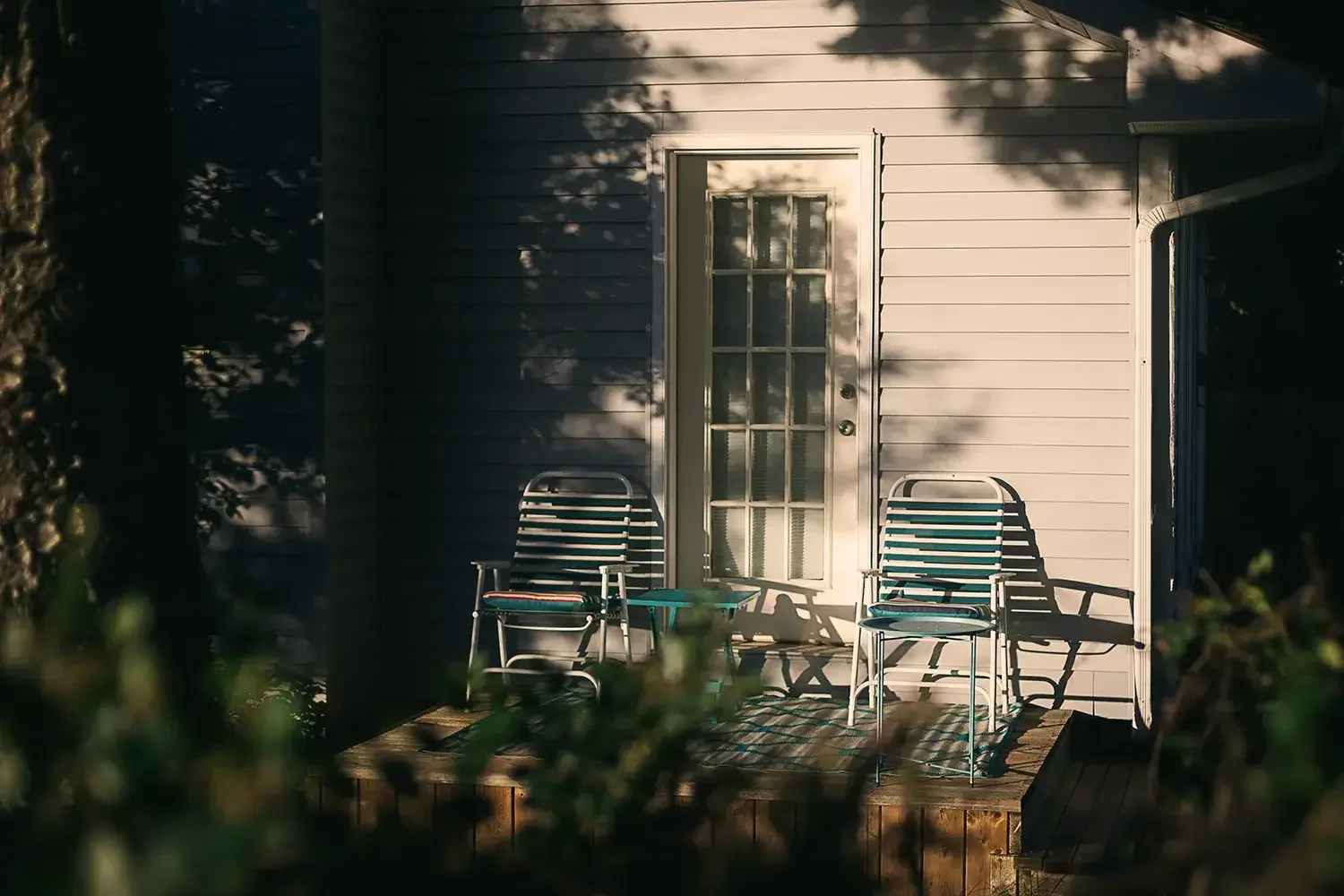
Image credit: Devon Mackay
The long hot summer had bleached all the colour out of South East England. Rows of manicured front gardens were now reduced to sad strips of straw – weeds taking over every nook and cranny in driveways and pavements. The dawn chorus crowded out by the continuous thrum of air conditioning units. A haze of dust had settled over parked cars – the air stagnant and slow moving, blanketing entire neighbourhoods. Lawn mowers, once parked like tanks on lawns, remained under lock and key.
Lizzie pulled back the net curtain and sighed. How she wished for over-cast skies and drizzle. Mr Tom would move soon from his early morning sunbathing spot on the back porch to the cool tiles in her back scullery. Lizzie carried the beaker of chilled water into the garden before easing her arthritic knees into the deckchair. She too would move inside later. The mercury recorded 28 degrees already and it was not yet 9am. That morning, she had woken to another vivid sunrise – intense oranges and pinks streaking the sky – the tiny particles of pollutants stirred up by the heat, scattering particles of neon light into the atmosphere.
The heatwaves, if you could even call them that anymore, had come thick and fast that year. Lizzie watched as an army of ants tunnelled under the patio slabs seeking refuge. The fountain, a gift from her children, had long stopped spouting water. Only the dandelion seedheads survived in her baked terracotta borders, the cracked earth flecked with the last remaining petals of long fallen marigolds and lobelia.
Lizzie could see the rows of babygrows and tiny crib sheets hanging motionless on her neighbour’s washing line. From an open upstairs window she could make out the faint gurning sounds of Molly. The long listless nights had played havoc with the baby’s routine. Her mother hollow eyed and ruinous – defeated by her first three months as a mother.
Peering through the chicken wire fence that separated her garden from no. 11, Lizzie watched as David continued to turn his house inside out. After his wife Pansy had died, he had devoted his days to D.I.Y. – each capital letter growing in stature with the enormity of the task in front of him. Now the innards of their once pristine home were piled high, exposed to the elements. A mattress that he had heaved outside had long since rotted, its metal springs glistening in the mid-morning sun. David stared at this mound of detritus gathering on his yellowing neckerchief of burnt grass and wiped the sweat from his brow. As he looked up, she smiled at him – signalling she understood. He nodded back before removing his ear muffs and returning back indoors.
Two gardens away the hives had stopped talking to each other. Diverted from honey production, the colonies had fanned their wings to create their own internal cooling systems before swarming in one furious long chain, up and away from Belle Vue Terrace. Their owners, Rebekah and Josh, had been devastated. The bees had been their first foray into eco tourism. In the first year, before the droughts came, they had touted their Belle Bees honey around local farmers’ markets. Now Rebekah eeked a living selling soaps from the remaining beeswax – a throwback to gentler times. Lizzie had welcomed the newlywed’s arrival – meeting them by chance when they had come to her rescue after she had tripped outside the local corner shop. Their earnestness had reminded her of her own two children – long since left home and with families of their own. Her grandchildren’s lives so very different – this generation kept indoors like delicate house plants, pale, allergy prone, anxious.
Lizzie watched as a stray honey bee circuited her garden vainly searching for nectar. She looked forward to these infrequent visitors. Fluttering just in front of her she could see up close its irridiscent thorax and abdomen corseted at the waist. How could we ever have treated these fragile survivors as pests? Now their gentle presence was just another echo of summers past.
Trees too were showing signs of stress. Once their crimson and burnt orange leaf fall signalled a return to school - that season of mists and melancholia so beloved by Romantic poets. Now their arrival in August tricked the senses into thinking the clocks had sprung forward. It was Nature’s way of getting its own back on humankind’s selfish ways. Branches lay where they had fallen, their amputated limbs scattered in deserted parks, the peeling bark a sun canopy for beetles, millipedes and centipedes.
That first summer when the trees had silently signalled to each other to drop their branches, it had been dismissed as a natural blip. Now this freak one-off had become the new normal and had an official title ‘Annual Branch Drop Period’. Councils fearing a rash of personal injury claims had ushered in new regulations. Public safety enforcers patrolled entrances to parks and green spaces during peak fall season. On the back of their uniform were emblazoned the words ‘Canopy Enforcement Unit’. Bright yellow triangular badges on their lapels warned of impending peril and danger of death - a tree with a jagged broken branch and a stick figure prone underneath. At first, the padlocked park gates and tree fencing had been met with quiet outrage. Then the protests started when the councils moved in with excavators, winches and stump grinders to uproot trees in children’s playgrounds. Scenes of families gathering outside locked green spaces, camouflaged in shades of brown and green, appeared nightly on TV screens. Public opinion was on their side. It took just one unintended blow for the tide to turn. One young man, picking up and hurling a large branch, javelin like, into the crowds, accidentally hit and maimed a toddler. Arrested and charged, the carrying of sticks and branches in public was soon classed as possessing a legal weapon. Soon after that the protests stopped, and the bulldozers moved in removing the worst offending trees in high traffic zones.
The tree fencing had other unintended consequences. Parents in high-rise flats warned there was no longer anywhere to go to escape the stifling heat – their children cooped up indoors. Swimming pool use was rationed to one session per week per family, and means tested. Now that free spaces such as parks and woodland were off limits – how where they expected to entertain their children for weeks on end during the summer holidays? Questions were raised at Parliamentary Question Time about these intolerable conditions. Before long a new legislative framework had been drawn up – the school year would now be broken up into quarters – each with a short intercession to give teachers and pupils some respite. Both sides of the House agreed this was a pragmatic solution – it would keep children indoors in regulated environments during periods of intense heat and it would avoid a ‘summer slide’ in academic performance. And, with parents no longer having to find childcare for six weeks every summer, the UK would become more productive. Children too would benefit - extrapolated the most enthusiastic proponents of the new Bill – never again would they face the boredom of a long school holiday. The unions were quick to demand higher pay for teachers as recompense and the government relented. The unions won again when further legislation was brought in to extend the school day during summer months. Summertime was now the ‘quiet’ season – even if there was no such thing as silence anymore - as children were safely kept off the streets and out of dangerous green spaces.
Lizzie gazed at the ancient oak tree at the foot of her garden and marvelled at its stoicism. So much had changed in the sixty years she had lived in this house – and for all that time the oak had been her constant watchful companion. She used to worry about its thickening root system that had caused all those gentle ridges along her lawn. Now it comforted her to think it had sourced its own water supply deep, deep down under her house. It was, Lizzie realised, humans who had become brittle, liable to snap under pressure. We didn’t have the resourcefulness of nature to adapt. Instead, we made new machines to make our lives bearable in a situation caused by our own making.
There had been a run on those cheap fans at first that gently churned the thick night air like soft whipped cream. Then the air con salesmen arrived selling their products as personal safety domes designed to ‘keep the outdoors out’. But the promises of total control soon evaporated when these cheap imports burnt out due to over-use. This, the state decided, called for a more radical approach.
It was Josh who had first pointed out to her the buzz emanating from their local library. Lizzie’s tinnitus had desensitised her to outside noise but now tuned in she could no longer block it out. AI powered cooling units had been installed in every municipal building, emitting a low pervasive waspish drone. Above this low pitch were staccato whirs, clicks and mechanical ticks as these smart systems constantly communicated with each other, transmitting complex data and optimal temperature commands.
These indoor regulated environments soon became designated safe places. To maximise spatial efficiency, it was calculated, a single large server could hold thousands of books. The logical solution was to remove the rows of bookcases and reading nooks and replace these with rows of ergonomic chairs all positioned facing a giant wall of screens. These screens could be multi-purposed to provide not just entertainment but a constant reel of public safety announcements, group presentations and real time news updates. This was far more equitable and inclusive – while only one person could read one physical book at a time, digital information could now be accessible to everyone. In these shared new Information Centres – as libraries were now called - all knowledge was publically owned, transmitted and carefully curated.
Lizzie slowly moved back inside, the kitchen door sealing her from this AI powered hive of activity. In this sudden stillness the high-pitched ring of her tinnitus returned – cocooning her in her own internal reality. She wandered over to her favourite armchair with its crocheted covers. Mr Tom, as if on cue, padded over and sprung onto her lap. Gently kneading his fur with her gnarled and stiff fingers, she reached for the remote. Immediately Today’s Public Information Feed flickered onto the screen on the wall together with a large 40 degrees warning. She searched through her own digital archive. Scrolling through the channels of her life – ‘wedding day’; ‘first grandchild’; ‘golden anniversary’ she selected ‘garden in summer’. A video shakily shot by her late husband showed footage of her younger self, kneeling over a rose bush, smiling, secateurs in hand. Their two boys, Toby and William, are sitting in one of the oak’s sturdy boughs. Above them the sky is over-cast and raindrops have smattered onto the video camera. Another summer in suburbia.
[Inspired by The Memory Garden, performed and composed by British-French guitarist Laura Snowden]